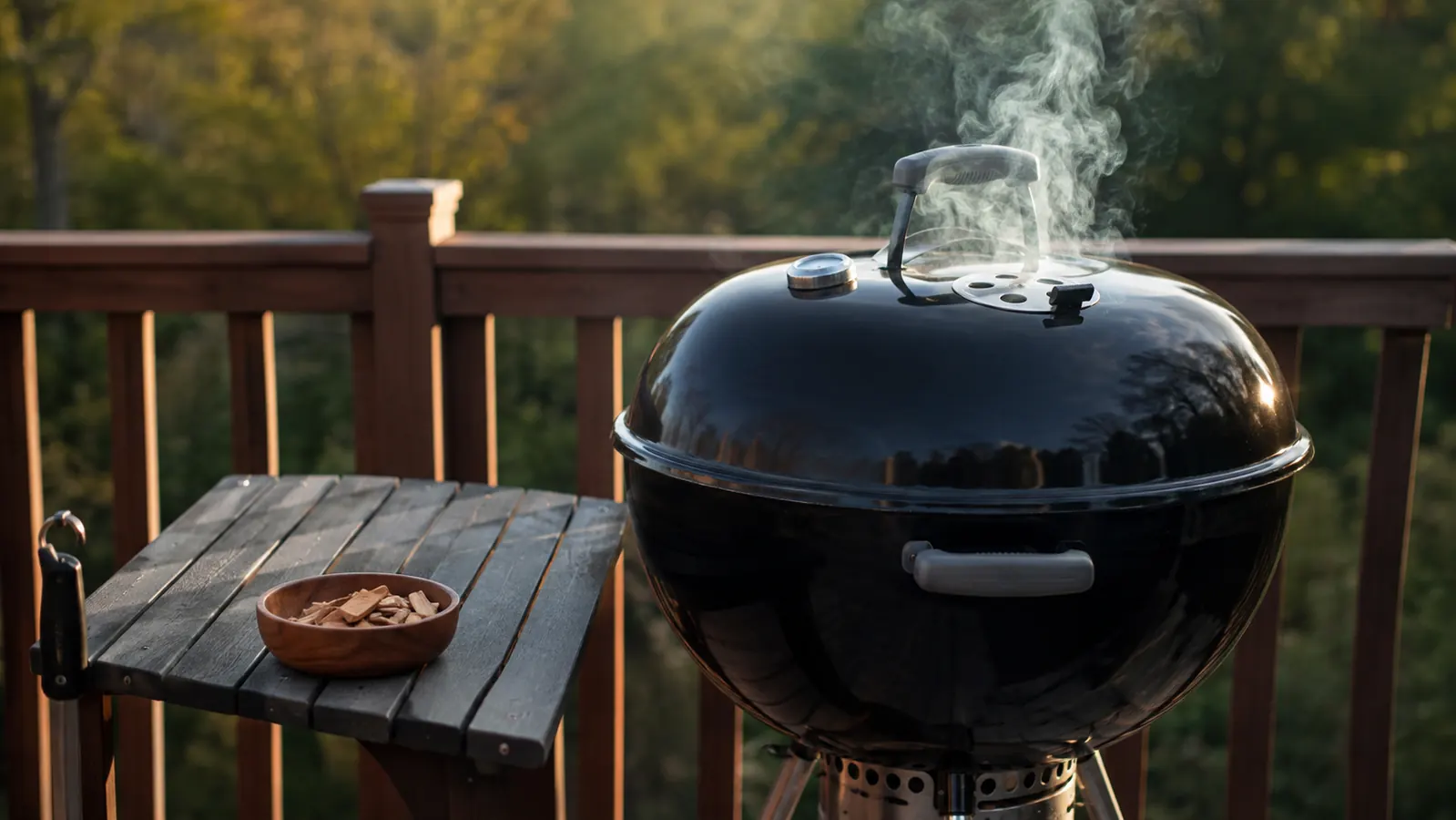
Every spring I get the same question from friends who watch smoke rolling out of my kettle: do I need one of those steel smoker boxes, or can I just wrap wood chips in foil and poke holes in it? I spent six Sundays on my back deck outside Dahlonega answering that question for myself, running the Skyflame Wood Chip Smoker Box against a homemade foil packet on the same 22-inch charcoal kettle, the same lump charcoal, and the same hickory chips. The short version is that the two are not competing for the same job. The Skyflame box is a tool you buy once and reach for whenever you want steady smoke on a long cook. A foil packet is a way to use what is already in your kitchen drawer. Both have a place. The trick is knowing which one you are actually in the mood for.
If you only want the verdict, here it is. The smoker box gives you steadier smoke over a long cook, and it will still be sitting in your cabinet next season. The foil packet gets you most of the way there for almost nothing, as long as you wrap it correctly and do not mind making a fresh one every time you need a refill. Neither method turns a charcoal kettle into a stick burner, and I would not pretend otherwise. But after six back-to-back Sunday cooks I have a clear opinion about which one earns its place when company is coming and which one I reach for on a weeknight when I just want a little hickory on chicken thighs.
Why This Question Comes Up
The confusion starts with the name. A smoker box sounds like a piece of equipment for a dedicated smoker, so plenty of home cooks assume it belongs on an offset or a bullet smoker and not on the grill they already own. On a kettle, the same little metal box sits right in the coals and does the same job it does anywhere else: it holds wood chips close to the heat so they cook slowly, smolder, and give off smoke instead of bursting into flame. A foil packet is the same idea using material you already have. In both cases the chips live in a partly closed container with small holes that keep them just below the point where they catch fire. That gentle smolder is what produces clean smoke rather than the bitter white smoke that rolls off a chip that is actually burning.
Where people go wrong is expecting the two to behave identically. A smoker box has fixed walls, a fixed volume, and holes positioned to draw a steady trickle of air. A foil packet is only as good as the fold and the poke. Get the holes in the wrong place, wrap it too loosely, or set it too close to the flame and you get a flare-up inside the foil that sours the first half hour of the cook. The question is not which method makes better smoke, because both are capable of good smoke on a short cook. The question is which one you can trust to make the same smoke all afternoon on a Sunday when six to ten people are about to sit down at your table.
| Skyflame Wood Chip Smoker Box | Foil Packet | |
|---|---|---|
| Upfront cost | A one-time purchase that lasts for years | A sheet of foil you already own |
| Smoke time per load | Roughly 45 to 60 minutes of steady smoke from a full box | 30 to 40 minutes if the wrap and the holes are right |
| Cleanup | Tip out the ash and wipe the box down | Crumple it up and toss it |
| Service life | Still square after a full season of Sunday cooks | One cook, then it is gone |
| Refilling mid-cook | Slide it out, add chips, set it back | Make a whole new packet and re-poke the holes |
| Best for | Longer cooks you do on a regular basis | A quick smoke on a weeknight |
How I Tested Both on the Same Cooker
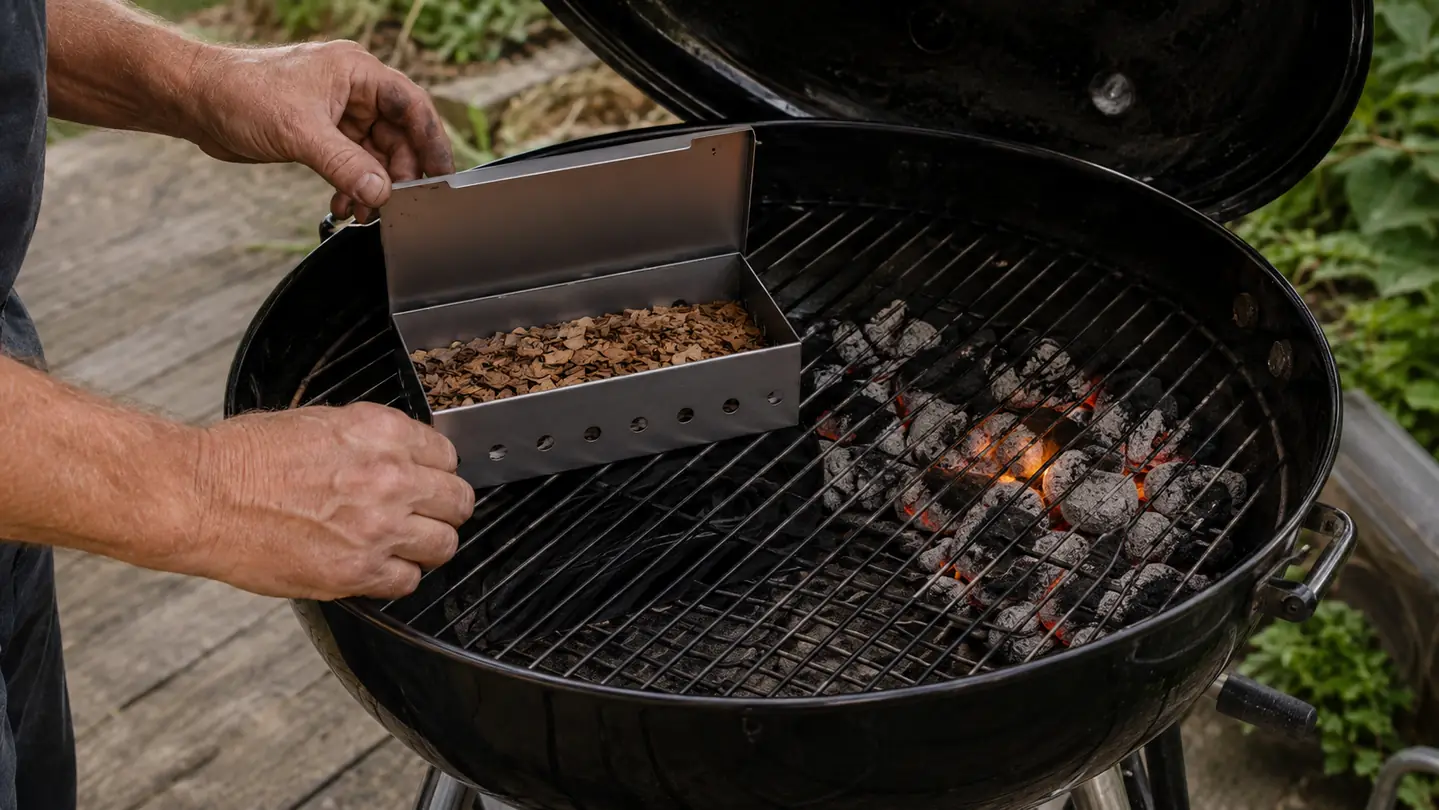
I ran this test on my 22-inch charcoal kettle, the one I bought used and have cooked on for over twenty years. Every Sunday from early April through the middle of May, I lit one chimney of lump charcoal, banked it to one side, and set a small pan of water on the cool side to hold the temperature steady. I kept the dome thermometer between 250 and 275 and let each cook run close to three hours. The first three Sundays I used the Skyflame box; the next three I used foil packets. The meat changed week to week, three batches of bone-in chicken thighs and three smaller pork shoulders, but the wood stayed the same: dry hickory chips from the same bag, about two cups per load.
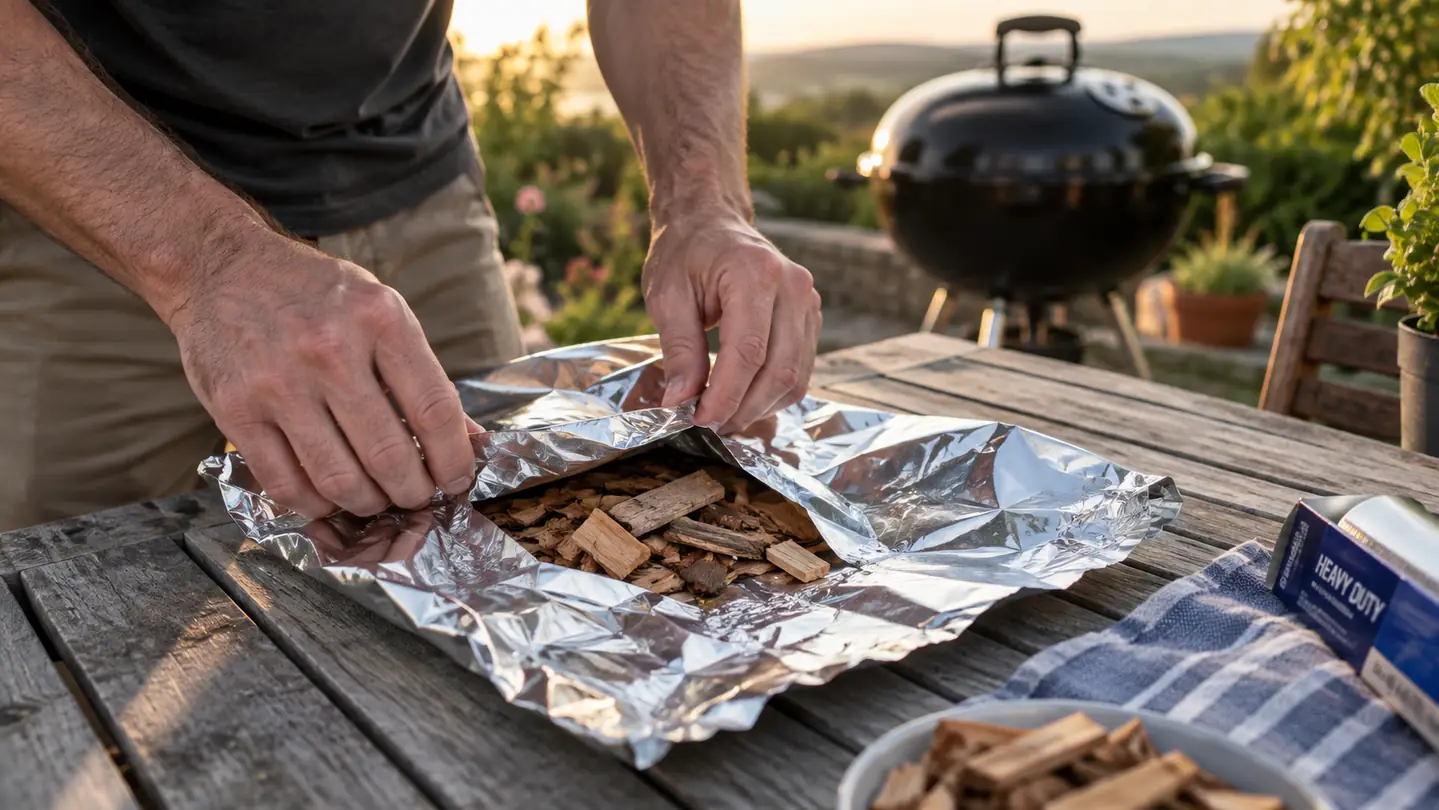
The foil packet took me a couple of tries to get right. The version that finally worked was a double layer of heavy-duty foil, the chips spread flat in the middle, the foil folded into a tight rectangle, then eight holes poked along the top with a metal skewer. Holes only on top. My first packet had holes on both sides, the chips caught, and that batch of chicken picked up a bitter edge I could taste for the rest of the meal. The Skyflame box needed none of that fiddling. I filled it about three quarters full, set it on the coal bed at the edge of the fire, and closed the lid. It was putting out thin, clean smoke within ten minutes and kept at it for close to 45 minutes before I had to top it up.
The pattern repeated every Sunday. The box gave a steady trickle of smoke for 45 to 50 minutes per load, and the smoke stayed thin the whole time. The foil packet gave 30 to 40 minutes and thinned out noticeably in the last ten as the chips turned to ash. I also noticed the packet needed more attention. When the coals settled, the packet slumped against the grate, and twice it slid down toward the ash pan. The box sat where I put it and stayed there.
Where Skyflame Wins
Consistency is the Skyflame box's whole argument, and it is the reason I would buy it again. When I filled it the same way each Sunday, it smoked the same way each Sunday. The steel box holds its shape when I slide it across the grate, the lid keeps the chips from gusting when the coals flare, and the fixed holes let in just enough air to keep the chips smoldering instead of burning. On the long pork shoulder cook, the one that ran a little past seven hours, I refilled the box four times and every load behaved like the one before it: thin smoke in ten minutes, steady for close to an hour, then a clear signal that it was time to add more. That is what you are buying with a smoker box. Not more smoke. Smoke you can count on.
The box also wins on the mechanics of a long cook. It is a solid object with a lip I can grip with tongs, so I can slide it out, set it on the ash pan, add chips, and put it back without touching the meat or dumping heat out of the kettle. It takes up very little grate space, which matters when you are cooking for six to ten people and every square inch is spoken for. Steel does not tear, it does not leak ash into the fire, and it does not blow away in a gust. Knock the ash out after each cook, keep it dry, and it will still be square next spring. Mine has been through a full season of Sunday cooks and shows nothing worse than a little staining on the bottom.
Where the Foil Packet Wins
Cost and cleanup are the foil packet's whole argument, and they are legitimate. The Skyflame box is a one-time purchase you have to keep track of, keep clean, and keep dry between cooks. The foil packet takes one sheet of foil and two minutes at the counter, and when the cook is over you crumple it up and drop it in the trash. No scraping, no rust worries, no drawer space lost. For someone who smokes a few times a year, that is a perfectly reasonable trade. You cannot wear out a foil packet, and you cannot lose it in the garage, because it does not exist until you make it.
The packet also wins on short cooks where the smoke only needs to run for 45 minutes or so. Chicken thighs, a quick rack of ribs, a chuck roast treated like a poor man's brisket, one packet will carry you through the whole cook, and cleanup is nothing. A packet can also be made any size you need. The Skyflame box holds about two cups of chips, full stop. When I wanted a heavier hit of smoke for a big cut, I rolled a packet with three cups of chips and let it run longer, though the smoke came out less even the bigger the packet got. That flexibility has real value on a weeknight.
I will be honest about the packet's limits. The window between not enough smoke and harsh smoke is narrow. Wrap it well, keep the holes on top, and set it at the edge of the coals, and you get a pleasant smoke for a short cook. My best foil packet runs were close to the Skyflame box on chicken. The gap only opened up on the long pork shoulder, where I had to make a fresh packet every 40 minutes and the third and fourth packets never behaved quite like the first two. By the end of that cook, I was not weighing flavor. I was weighing annoyance.
For the long cooks, the box earns its spot
A single fill of the Skyflame box smolders for close to an hour, and after a full season of Sunday cooks mine still looks like the day it arrived. It has more than 1,700 ratings on Amazon and a 4.5-star average. Check today's price and see if it fits the way you cook.
Amazon Check Today's Price on Amazon →What About a Gas Grill
I should be clear that I ran this comparison on charcoal, because that is the grill I own. I do not have a gas grill on my deck, and I have not run the Skyflame box on propane myself. The question comes up every time I talk about the box with neighbors, so here is the practical side of what I know from helping friends with their setups. On a gas grill you set the box on the flavorizer bars directly over a lit burner, close the lid, and let it go. A foil packet can sit in the same spot. The thing to watch is the same on gas as on charcoal: you want the chips to smolder, not burn. If the smoke turns white and bitter, the chips are too close to the flame or the holes are too large.
Who Should Buy Which
Buy the Skyflame box if you smoke food more than a couple of times a month. If you are the person who plans a pork shoulder for Sunday, if you keep a bag of chips by the grill, if you want next weekend's cook to taste like last weekend's cook, the box will earn its keep inside a single season. It is also the easier choice if you want one method that works whether you are on the charcoal kettle you own today or a gas grill you might buy down the road, because both accept the same box the same way.
Skip it if you smoke twice a year, or if your smoking is mostly quick things where 40 minutes of smoke is the whole point. The foil packet does that job with nothing to store, clean, or remember. There is no shame in that answer. I still use a foil packet myself on weeknights when I want a light smoke and do not feel like pulling the box out of the cabinet. The box does not make sense for every person, and pretending it does would be bad advice.
Here is the straight answer after six Sundays of back-to-back cooks. If you are new to smoking, start with foil packets. Learn what clean smoke looks like, learn how chips behave as the coals age, and learn whether you actually like the flavor before you spend money on gear. The day you find yourself making your second or third packet in one afternoon and wishing there were an easier way, that is the day the Skyflame box stops being an accessory and becomes the obvious answer. That is exactly how I ended up with mine, and a season later I have never once wished I had stuck with foil.
The Skyflame box is the one I keep by the kettle
It gives steady smoke on the long cooks, survives a full season without rust, and it has more than 1,700 ratings behind it on Amazon. Check today's price to see if it fits the way you cook.
Amazon Check Today's Price on Amazon →