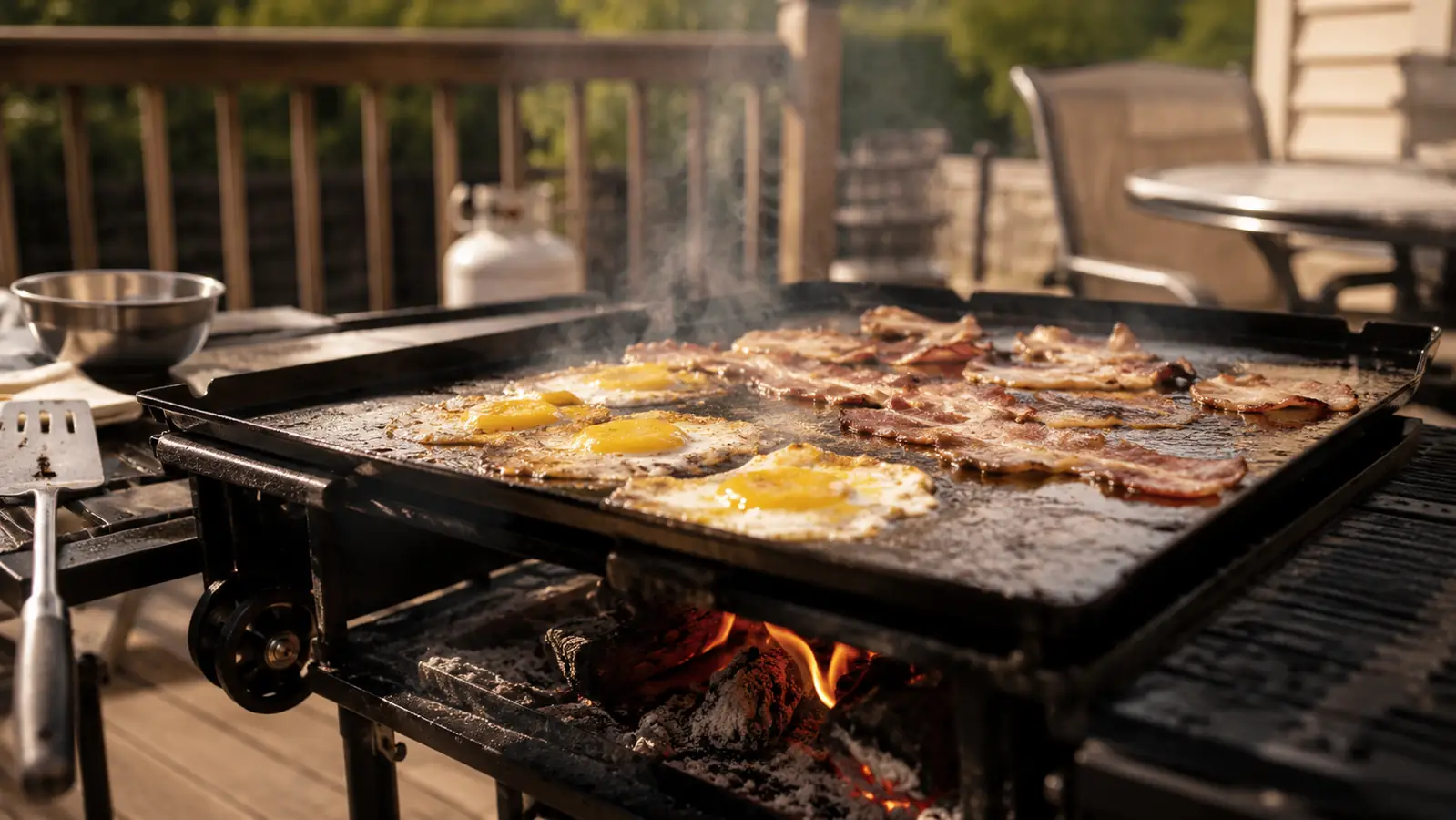
The listing photo for the Utheer cast iron griddle shows an egg sliding across the surface like it is on ice. That photo is doing real work, because it promises that cooking on a flat top is effortless. My first egg on this griddle did not slide anywhere. It stuck to the surface, then it cooked, then it came off with a spatula and a bit of patience. Three months later the surface is better, and so is my breakfast. But the honest version of this review starts with the gap between that photo and the first few cooks. That gap is where most people decide they have made a mistake.
I am Marlin Cobb, fifty-eight years old, and I live outside Dahlonega in north Georgia. I have been cooking on the same back deck for more than twenty years, on a charcoal kettle and on an offset stick burner I welded a new baffle into myself. I burn lump charcoal and split oak and hickory from my own property. This griddle arrived near the start of a humid summer, and that detail matters more than I expected. A cast iron griddle this size is not an accessory. It is a commitment, and the listing does not say that in so many words.
The Quick Verdict
An honest piece of cast iron that cooks well once you accept its terms. It is heavy, slow to heat, and it demands care. Given that care, it turns a charcoal grill into a flat top that feeds a crowd.
Amazon Check Today's Price →The flat top that fixed my Sunday breakfasts
The Utheer 25 by 16 inch griddle has its quirks, and this review names every one of them. If you already own a grill and want a real cooking surface, check today's price and read what recent owners say before you decide.
Amazon Check Today's Price on Amazon →How I've Used It
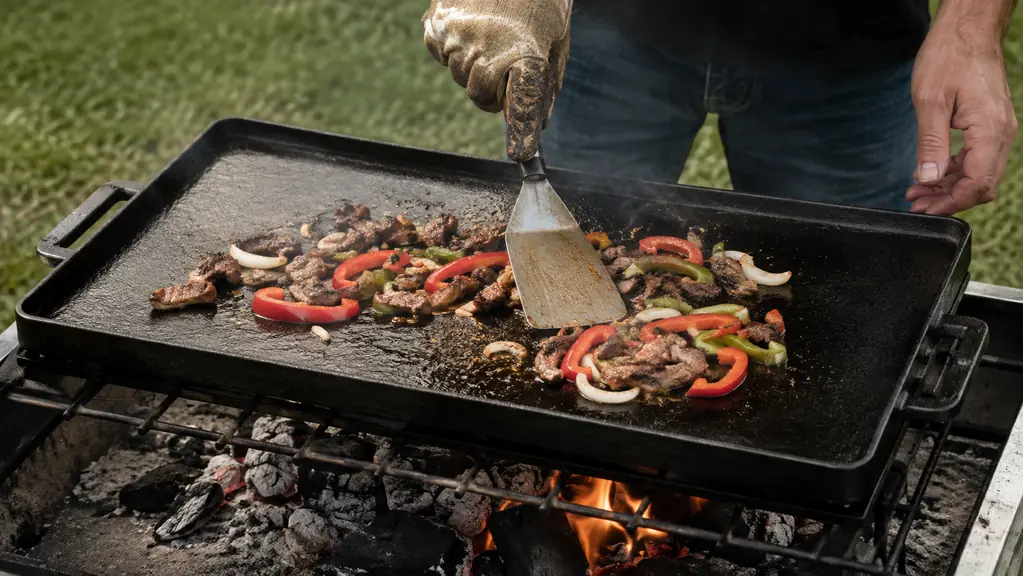
My 22-inch charcoal kettle is where this griddle has lived since it arrived. The offset stick burner is not built for a flat surface, so the kettle is the natural home. I cooked on it most weekends for about three months, plus a few weeknights when the weather held. Deb and I feed whoever turns up on Sundays, usually six to ten people, so the griddle got real work instead of one showcase cook. Bacon by the pound, sausage patties, eggs for a crowd, pancakes, smash burgers, and one batch of chicken thighs that taught me exactly where the hot spots live.
The first cook told me most of what I needed to know. I set the griddle over a full chimney of lump charcoal and gave it fifteen minutes to come up to temperature. Then I laid down a pound of bacon. The bacon cooked the way bacon should. The eggs I tried right after did not, because I had not given the surface enough fat or enough time to build a layer. I do not blame the griddle for that. I blame the sliding egg in the listing.
One note before I go further: my setup is charcoal only, so everything I say about fire management is about coals. On a gas grill you would have a knob to turn and a steadier bed of heat under the same griddle. The fuel does not change the cast iron. The same weight, the same seasoning needs, and the same cleaning routine follow this griddle no matter what heats it. If you run propane, read the gas-specific notes as the path you would take, not a path I have walked.
What the Listing Does Not Tell You About the Surface
The griddle arrives pre-seasoned, and that claim is true as far as it goes. It is not the same as a surface that is ready for eggs. Out of the box, parts of the cooking surface looked dry and patchy, which is normal for factory seasoning and still a small letdown when you have waited on shipping. The fix is boring and reliable: cook a pound of bacon first and pour off the fat as it builds. The bacon fat lays down the layer the factory only started.
The listing also says nonstick, and that word deserves a footnote. After three months of scrubbing and oiling, I am convinced the nonstick comes from the seasoning, not from a coating. The griddle still wants fat on the surface and heat behind it. Smooth and well seasoned is not the same as a coated pan, and anyone who buys this expecting an effortless first cook will be disappointed in the first five minutes. Adjust that expectation and the griddle rewards you.
I ran the same egg test on cook one, cook six, and cook twelve. Cook one stuck and needed the spatula. Cook six came up clean with a little butter. Cook twelve slid almost the way the photo promised. That progression is the entire story of cast iron, and the listing does not mention it anywhere. The product improves with use, and the improvement is yours to create.
One more thing about the surface: do not panic when the seasoning looks uneven in the first weeks. Factory seasoning will wear through in places, and you will see patchy spots that look like a mistake. That is the layer evening out, not the griddle failing. Keep cooking bacon and burgers, keep wiping on a thin coat of oil after each meal, and the patchiness disappears on its own. I almost scrubbed mine back to bare iron in week two, and I am glad I did not.
The griddle does not arrive as the surface in the photo. It becomes that surface, one oily cook at a time.
Weight and Handling: The Part Nobody Puts in the Listing
Cast iron at this size is heavy. That is the honest sentence the marketing avoids. This is a 25 by 16 inch slab of iron. I can move it, but I think about it every time, and I have stopped pretending I will ever handle it one-handed. I keep it on a shelf in the shop when it is not in use and carry it to the deck with both hands and a clear path. If you have a bad back, a weak grip, or a storage spot at shoulder height, measure your situation before you order.
Moving it while it is hot is the part nobody warns about. The whole slab gets hot, including the edges, so any mid-cook adjustment calls for a good pair of heat-resistant gloves. On my kettle the griddle covers the entire cooking area once it is down, which means there is no convenient way to add charcoal without lifting a hot slab of iron. I learned to start with extra fuel or to accept that I am cooking for the life of that coal bed. That planning problem is not in any review I read before buying.
Storing it takes as much thought as lifting it. A 25 by 16 inch slab does not tuck into a cabinet the way a skillet does. I keep mine on a sturdy shelf in the shop with a small gap around it so air can move. If you plan to store it inside a grill when it is not in use, make sure that grill is fully dry first, because an enclosed space traps humidity and undoes all your care. Where this griddle lives matters as much as how you cook on it.
The Boring Truth About Heat on Charcoal
Cast iron takes its time coming up to temperature, and nobody puts that in the listing either. I give the griddle a full fifteen minutes over a settled bed of lump charcoal before anything touches it. Rush it and the center cooks while the edges run cold. Cast iron evens out once it is fully hot, but getting there is not quick, and cooling down is just as slow. This is a tool for a relaxed cook, not a shortcut.
Even when it is fully hot, the griddle only spreads the heat you give it. A charcoal fire is never perfectly even, so the griddle is never perfectly even. I found my hot spots during that batch of chicken thighs, and I still work around them every time I cook. I rotate the food, I leave gaps, and I know which third of my surface runs hot. A gas grill behaves differently because the burners underneath make a steadier pattern of heat, and that is the one thing that would be easier with propane.
Then there is the grease, and this is the part nobody films for the advertisement. On a gas grill with a proper drip tray, fat has somewhere to go. On my kettle the griddle sits flat over the coals, so bacon fat gathers at the edge and drips down into the fire. You get flare-ups. You also get smoke, because that fat is burning directly under the food. I keep a spray bottle of water within reach for fatty cooks, and I do not run a pound of bacon over charcoal without it.
I also learned to read the heat before the first pancake goes down. A drop of water on the surface should dance and evaporate quickly, not sit and boil slowly. If it boils slowly, the griddle is not ready, no matter how long you have waited. If it evaporates instantly, back off the coals a little. That water test saved more than one batch of pancakes and it takes two seconds.
Cleaning and Care: The Real Cost of Ownership
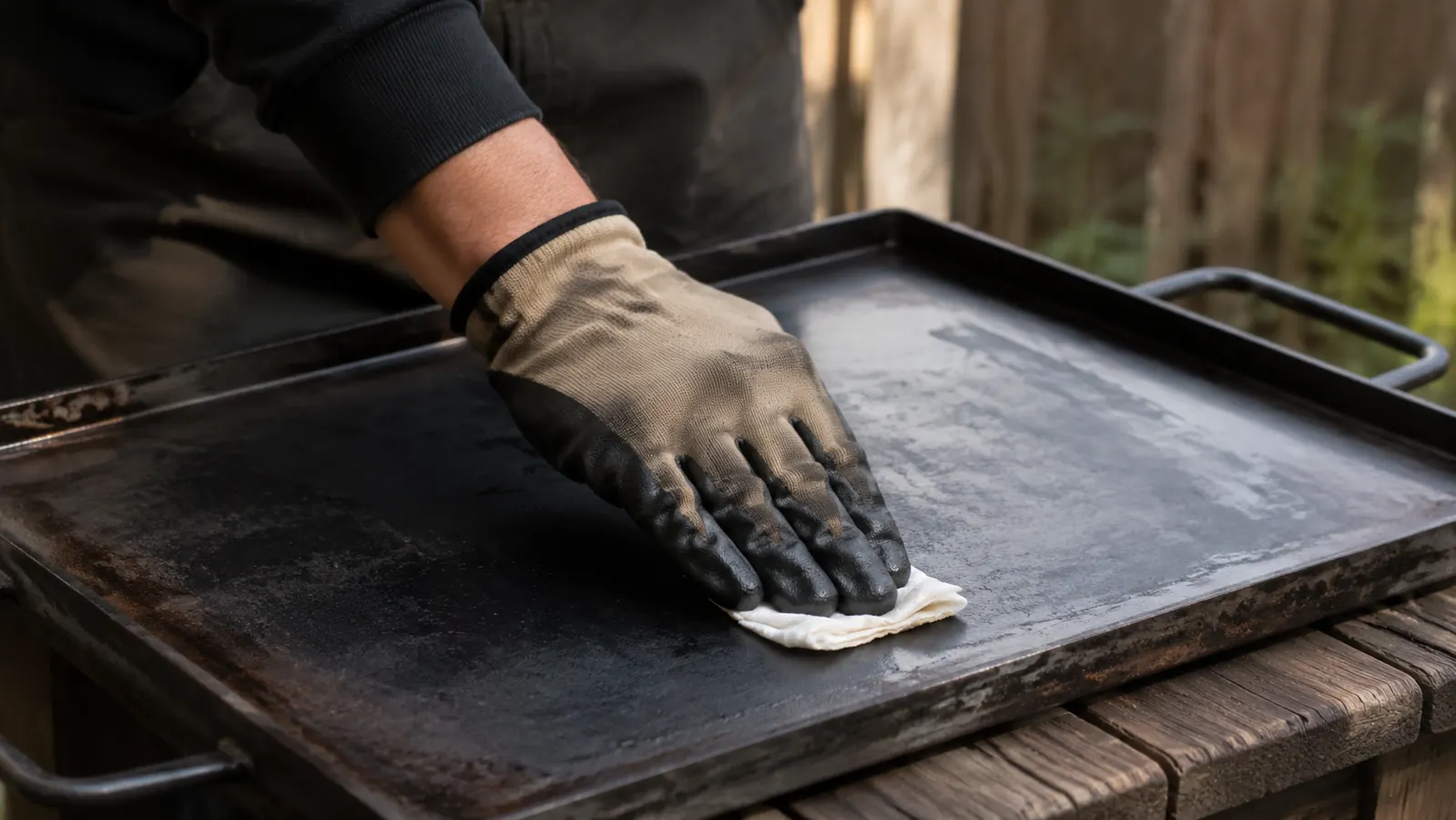
Cleaning is where the honest reviews earn their keep. You cannot let this griddle soak. You cannot run it through a dishwasher. You cannot leave it wet and walk away. My routine takes about ten minutes after every cook. I scrape the surface while it is still warm, wipe it down, and if anything stuck, I bring a little water to a simmer on the surface to lift it. Then I dry it over the remaining heat and rub in a thin layer of oil before it goes back to the shelf.
In north Georgia, the real enemy is humidity. I picked up a patch of surface rust on one corner after a rainy week when I left the griddle in the shop without its oil layer. I scrubbed the rust off with a little effort, fixed my routine, and it has not come back. That episode taught me the actual cost of this purchase. Cast iron care is not difficult. It is simply forever. Every cook ends the same way, and every single cook asks for the same ten minutes, month after month.
What you get in exchange is a surface with memory. After three months, mine cooks eggs, pancakes, and smash burgers better than any indoor pan I own, because the seasoning keeps building. Steel griddles reach the same place with less weight, but they rust faster and warp if you shock them with cold water. That makes the cast iron versus steel griddle question a real tradeoff instead of an obvious answer, and the comparison on this site lays it out row by row.
On the soap question, I will give you my honest position. A tiny dab of plain dish soap on a paper towel is fine for cleaning off grease, despite what the old-timers say. What ruins cast iron is soaking and water left behind, not soap. I rinse quickly, dry the griddle over heat until the water is gone, and oil it while it is still warm. That method has kept my surface rust-free and slick for three months of steady cooking.
What I Liked
- Large 25 by 16 inch surface replaces two or three pans at once
- Holds heat steadily through a full breakfast for six to ten people
- Pre-seasoned surface turns properly slick with regular use
- Works over charcoal or gas, so it is not a one-kettle purchase
- Ten minute cleaning routine keeps it ready for the next cook
Where It Falls Short
- Weight makes it hard to lift, store, and reposition
- Factory seasoning is patchy and the first cooks will stick
- Slow to heat and slow to cool, so you must plan ahead
- Hot spots over charcoal need attention every time you cook
- Fat dripping into the coals causes flare-ups and smoke
- Rust moves in fast if you skip the oil even once
Who This Is For
The Utheer griddle is for the cook who already owns a grill and wants a flat top without buying a second machine. It is for someone who feeds a crowd, who does not mind a ten-minute cleaning routine, and who understands that cast iron gets better with age instead of worse. If you cook burgers, chicken, pancakes, or a full breakfast on weekends, this surface will cook them in volume. And if you accept that the first few cooks are practice, the payoff is a cooking surface that keeps improving for years. My Sunday breakfasts changed because of it, and Deb noticed before I said a word.
Who Should Skip It
Skip the Utheer if you want effortless results from the very first cook, because the first eggs will stick and the cleaning never stops. Skip it if you have a small grill that cannot carry a 25 by 16 inch slab, or if lifting that slab is a problem for your back or your storage. Skip it if your griddle cooking is mostly breakfast for two, because a griddle insert that drops into your existing grate can fix breakfast cooks without asking you to store a second piece of iron. And if the honest answer is that you want light weight and no maintenance, a steel griddle will treat you better than the Utheer will.
Ready to give a flat top an honest try?
The griddle is heavy, the routine is real, and the payoff is the best breakfast I have cooked outdoors. Check today's price on Amazon and read the newest owner reviews to see whether this flat top earns a place on your grill.
Amazon Check Today's Price on Amazon →